 Available in A4 (£7.99) or A3 (£10.99)
Description
A Journey Across the Desert
Released for PlayStation 3 in 2012, Journey is an atmospheric adventure centred around a mysterious traveller crossing an enormous desert towards a distant mountain. There is no traditional dialogue explaining who the traveller is or why they are making the journey. Instead, the game uses its environments, music, animation and visual storytelling to communicate its world.
The traveller begins alone among the ruins of a long-forgotten civilisation, gradually discovering the remains of a culture that once flourished across the desert. Ancient structures, enormous stone monuments and mysterious symbols provide clues about the world and its history. As the journey progresses, the landscape changes and the mountain gradually becomes closer, providing a constant visual destination throughout the adventure.
The simplicity of the objective is part of what makes Journey so effective. There is a mountain in the distance, and the traveller must find a way to reach it.
The Mysterious Traveller
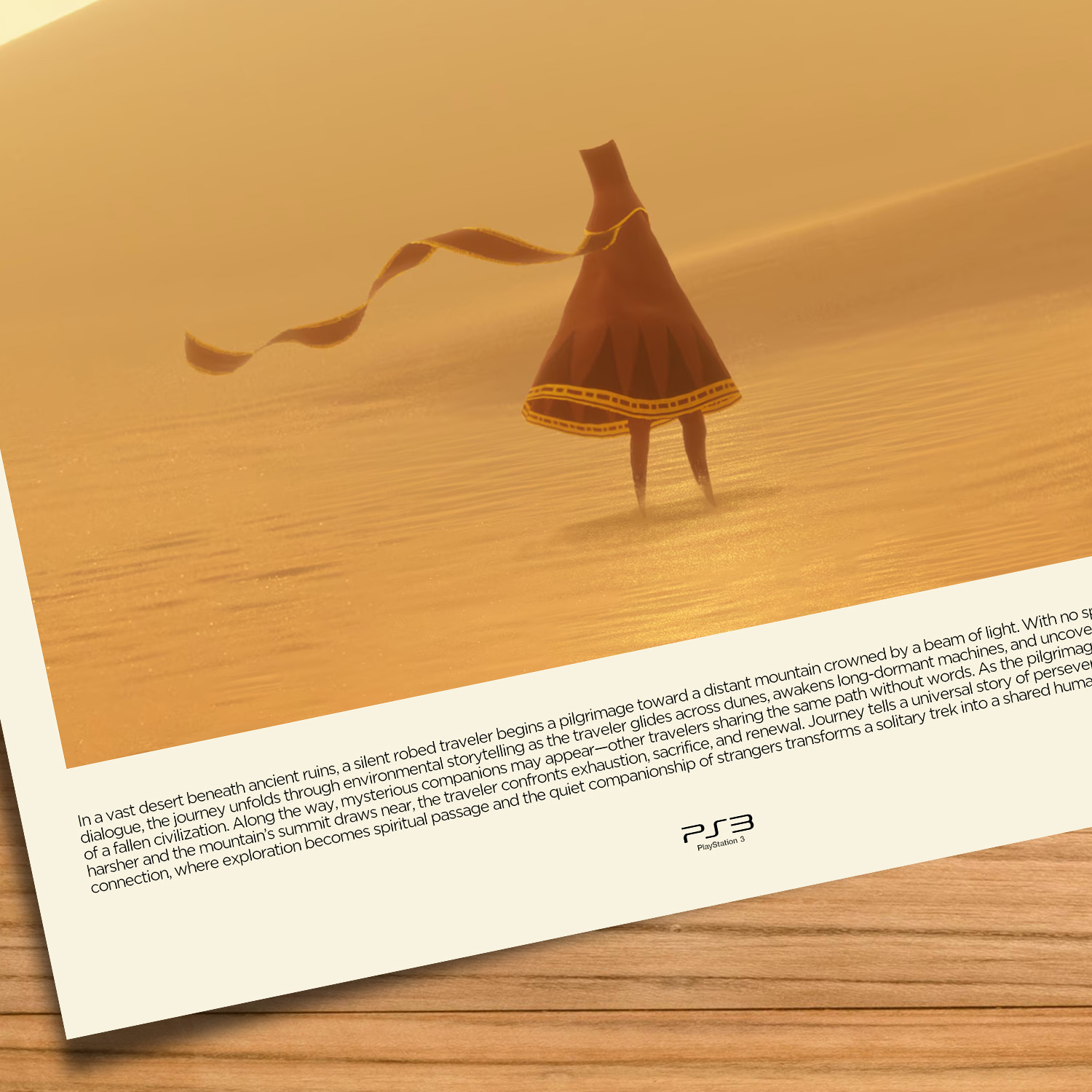
The game’s protagonist is deliberately anonymous. Players control a small robed figure whose identity and history are never explained in conventional terms. The character’s appearance is simple, with a flowing red scarf providing one of the most recognisable visual elements of the game. The scarf also has an important gameplay function. As the traveller explores, pieces of glowing cloth can be collected to increase its length, allowing the character to leap and glide further through the environment.
This creates a direct connection between the visual design and the gameplay itself. The traveller’s small size against the enormous landscapes reinforces the feeling of scale throughout the game. Vast deserts, ruined structures and towering mountains make the character appear tiny, creating some of Journey’s most striking visual compositions.
A Wordless Adventure
One of Journey’s defining characteristics is its lack of conventional communication. There is no spoken dialogue and players cannot communicate with one another using traditional voice or text chat. Instead, travellers can make simple musical sounds and use movement to communicate. This becomes particularly interesting when another player appears during the journey.
Journey can bring two anonymous travellers together, allowing them to explore the world alongside one another. Neither player is given a conventional identity or profile to focus on. They simply encounter another traveller and decide whether to continue together. That temporary relationship can become one of the game’s most memorable elements.
The absence of traditional communication encourages players to understand one another through movement, exploration and simple musical signals.
The Ruins of a Lost Civilisation
As the traveller crosses the desert, the remains of an ancient civilisation begin to reveal themselves. Ruined buildings, stone pathways and mysterious murals hint at what happened to the people who once inhabited the world. Rather than presenting the history through lengthy cutscenes or written explanations, Journey allows players to piece together the story from what they encounter.
The environment gradually changes as the traveller progresses. The early desert sections give way to ancient ruins and increasingly imposing structures, eventually leading towards colder and more dangerous environments near the mountain.
This progression creates a strong sense of movement throughout the adventure, with every new area feeling like another stage of the traveller’s journey towards the distant destination.
Music and Atmosphere
Music is an essential part of Journey’s identity. The soundtrack responds to the player’s movement and surroundings, helping create a sense of scale and emotion without relying on conventional dialogue. The combination of music, lighting, animation and environmental design gives the game a remarkably cinematic quality.
Even simple actions such as sliding down a sand dune or gliding between ancient structures can feel significant because of the way the game’s visual and musical elements work together. This atmosphere is one of the reasons Journey became so closely associated with the PlayStation 3 era and why it remains a distinctive example of how games can tell stories without relying on traditional narrative techniques.
A Defining PlayStation Experience
Journey was developed by thatgamecompany, the studio behind earlier experimental PlayStation titles such as Flow and Flower. The game became particularly notable for its approach to multiplayer, storytelling and visual design, demonstrating that a game could create a meaningful experience without conventional dialogue, combat or complex interfaces. Its minimalist approach makes it very different from many of the large-scale action and open-world games associated with the same generation.
For PlayStation collectors, Journey also represents an important part of the PS3’s downloadable-game era, when smaller independent experiences could sit alongside major retail releases and develop their own distinctive identities.
The result is a game that remains instantly recognisable from a single image: a lone traveller in a desert, looking towards a distant mountain.
Journey and the Wider PlayStation Collection
This Journey poster fits naturally alongside other atmospheric PlayStation adventures. The quiet exploration and environmental storytelling can make it a particularly interesting companion to an Ico poster, while the mysterious landscapes and minimalist storytelling also provide a natural connection to Shadow of the Colossus.
Those games approach their worlds very differently, but all three demonstrate the ability of PlayStation games to build memorable experiences around atmosphere, exploration and visual storytelling.
For a wider PlayStation gaming wall, Journey also provides a striking contrast to more action-focused games, with its clean visual identity and distinctive desert setting immediately standing out.
Design & Style
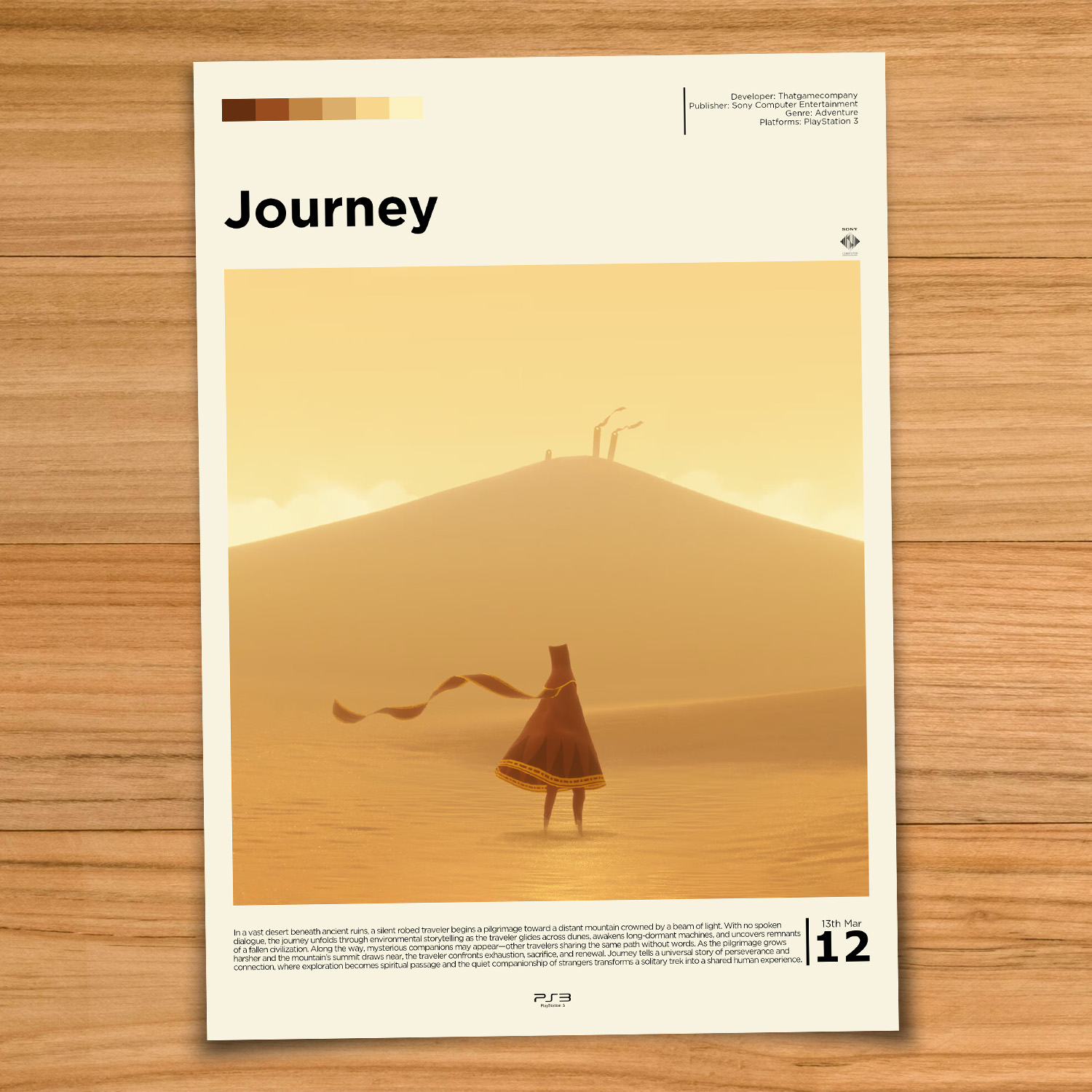
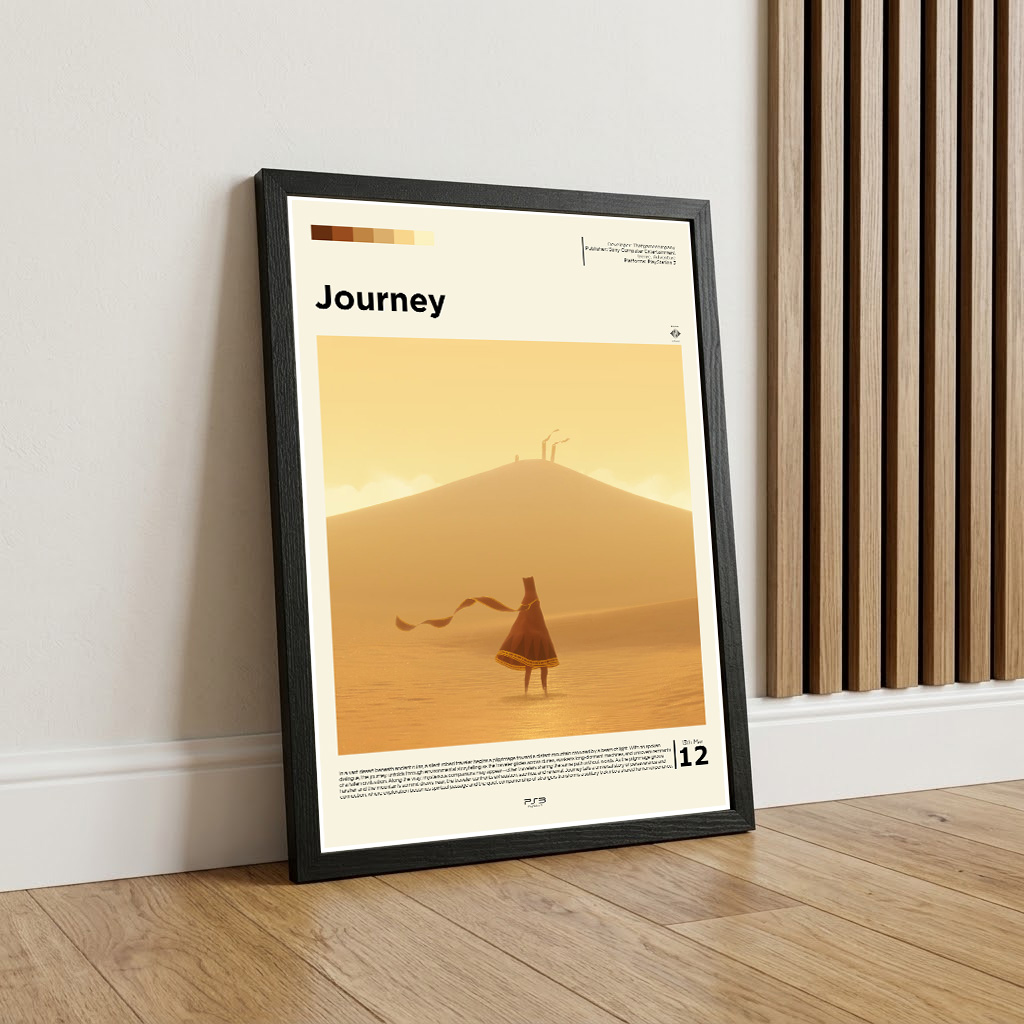
This Journey poster uses the game’s official key art as its main image, capturing the mysterious robed traveller against the vast desert landscape and distant mountain. The Journey title is positioned directly above the main artwork, giving the design a clear focal point while keeping the artwork itself at the centre. At the top right, the poster presents key information about the game, including the developer, publisher, genre and original launch platform. At the top left, six colour swatches are sampled directly from the artwork, creating a palette based on the game’s distinctive desert tones.
Below the main image is a concise synopsis of the traveller’s journey and the world surrounding them, accompanied by the game’s original release date. The original PlayStation 3 platform branding is positioned along the bottom of the design, completing the layout and reinforcing the game’s connection to its original platform.
The result is a clean, minimalist gaming print that complements Journey’s own visual style while fitting naturally into the wider Gamers Gallery collection.
Print Details
- A4: 210 × 297mm
- A3: 297 × 420mm
- Printed on 240gsm Premium Gloss Photo Paper
- High-quality full-colour print
- Official game artwork-inspired design
- Carefully packaged for safe delivery
Shipping
- Free UK shipping
- International shipping available
- Securely packaged to help protect your poster during delivery
Perfect For
- Journey fans
- PlayStation 3 collectors
- PlayStation gaming collections
- Fans of atmospheric and artistic games
- thatgamecompany fans
- Fans of Ico and Shadow of the Colossus
- Gaming rooms and home offices
- Fans of minimalist gaming wall art
Save 25% When You Add More Posters
Building your gaming wall? Add two or more posters to your order and you’ll automatically receive 25% off. There’s no discount code to enter — the saving is applied automatically at checkout.
25% OFF WHEN YOU BUY 2+ POSTERS – DISCOUNT APPLIED AUTOMATICALLY